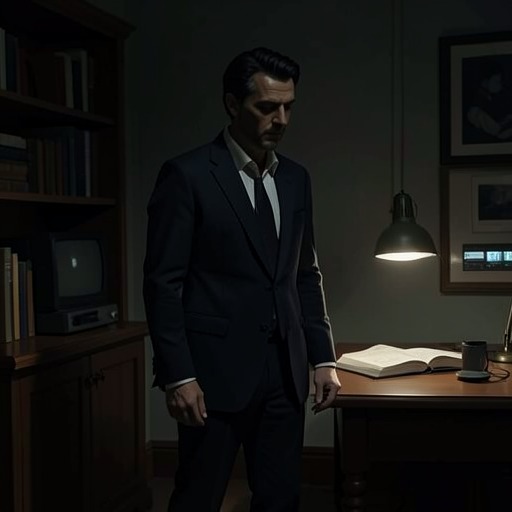
Mr Ramsay's Q-to-R crisis and Mrs Ramsay's consolation
To the LighthouseMr Ramsay's Q-to-R crisis and Mrs Ramsay's consolation is a scene in which an intellectual impasse becomes a test of family feeling. Mr Ramsay can establish Q but cannot reach R, and his private struggle expands into fantasies of polar hardship, heroic endurance, and lasting fame. When he turns to his wife and son, James experiences the appeal for sympathy as an intrusion, while Mrs Ramsay answers it with the sustaining force of domestic care. Her success comforts her husband, but the scene also reveals its cost: she must make herself the source of reassurance while concealing uncertainties that complicate their marriage.
The Alphabet and the Crisis of Thought
Mr Ramsay’s mind is figured as a keyboard or an alphabet of twenty-six ordered letters. He has advanced, by accurate and strenuous thought, to Q—a point the narration presents as an achievement few in England attain—but the next step defeats him. He braces himself to proceed, knocks the ashes from his pipe against the stone urn, and tries to formulate R. The small physical action gives the abstract problem a material setting: his effort is measured against the geraniums and the urn beside which he stands.
The alphabet makes intellectual achievement both orderly and uncertain. Mr Ramsay distinguishes between the rare genius who apprehends all the letters at once and the steady thinker who proceeds methodically from A to Z. He disclaims genius but takes pride in the capacity to work through the sequence accurately. Yet at Q he is stuck. The contrast does not simply rank two kinds of mind; it makes his chosen virtue—patient, exact labor—feel insufficient at the very moment he depends on it. R becomes less a letter than the threshold he fears he cannot cross.
As he struggles, imagined voices declare that R is beyond him and that he is a failure. A flicker of darkness obscures the letter, and his body registers the crisis: his forehead veins bulge, his eyes pale, and he seems, within only minutes, like an aged man. The narration enlarges the effort into scenes of extreme endurance: a ship’s company stranded at sea with six biscuits and a flask of water, then an expedition crossing the icy Polar region. These comparisons grant dignity to intellectual labor while exposing the scale of Mr Ramsay’s self-dramatization. His mind is genuinely strained, but the scene also shows how readily he casts private inadequacy in the terms of public heroism.
Heroism, Fame, and the Need to Be Seen
Mr Ramsay imagines a dying leader who refuses to lie down, instead standing against the storm in a final effort to pierce the darkness. He knows he will never reach R, yet asks whether a person who has honestly given all his strength can be blamed for not attaining the furthest point. The imagined expedition turns academic limitation into a question of moral worth: if he cannot be the exceptional thinker who reaches Z, perhaps he can still claim the honor of having persevered.
That consolation leads him to consider how posterity will remember him. He wonders whether his fame might last two thousand years, then measures such duration against the vast ages in which even a stone kicked with a boot may outlast Shakespeare. His own light, he recognizes, would shine briefly before being absorbed into larger lights. Still, he squares his shoulders beside the urn, imagining search parties finding him dead at his post and grateful followers raising a cairn over his bones. The posture makes visible his wish to be recognized as having endured, even when he doubts the value or duration of his work.
The heroic fantasy finally gives way to a bodily, immediate need. Mr Ramsay feels that he lives and does not object to living; he wants sympathy, whisky, and someone to hear the story of his suffering. His wife and son, first perceived at a distance, become clearer as he approaches the window. He bends his head before Mrs Ramsay and pays homage to the beauty of the world. The movement from remote fame to the familiar sight of his family is a narrowing of scale: the recognition he seeks from future generations is replaced, for the moment, by the comfort of being received at home.
James’s Resistance and Mrs Ramsay’s Response
James hates his father for interrupting the simple closeness of reading with his mother. He resents Mr Ramsay’s gestures, self-importance, and demand for attention, and especially the emotional disturbance that threatens the ease of their relationship. James fixes his eyes on the page and points to a word in the hope that his father will move on and his mother will return her attention to him. But Mr Ramsay remains, asking in effect to be noticed and comforted. The conflict is therefore not only between father and son: it is also a struggle over who can claim Mrs Ramsay’s attention.
Mrs Ramsay responds by straightening herself and turning toward her husband. Though she continues knitting, the narration represents her as gathering and directing energy, a force of life that can warm and restore him. Mr Ramsay repeats that he is a failure. She first invokes Charles Tansley’s high opinion of him as a great metaphysician, but praise alone is not enough: he wants sympathy and assurance that he is needed, not merely admired. Her response supplies that reassurance by imagining the rooms of the house—the drawing-room, kitchen, bedrooms, and nurseries—filled with life and open to his presence.
The comfort works through more than argument. Mrs Ramsay’s laugh, poise, and competence make the house seem real and secure; she assures him that, however deeply he buries himself or climbs high, he will not be without her. James, standing stiffly between her knees, feels her strength rise around them, even as he sees it being consumed by his father’s repeated demand. When Mr Ramsay is at last restored, he says he will take a turn and watch the children playing cricket, then leaves. The promised attention shifts outward to the children, but it arrives only after Mrs Ramsay has given her husband the sympathy he requires.
The Cost of Consolation
Once Mr Ramsay has gone, Mrs Ramsay folds inward with exhaustion. She has only enough strength to move a finger across the page of Grimm’s fairy story. The narration describes her exertion as a successful act of creation: she has temporarily made a world in which her husband can feel sheltered and alive. The image of a pulse that reaches its full width and then subsides captures both the accomplishment and its depletion. Her reassurance is not effortless kindness; it draws upon the energy she has just marshalled to hold the household together.
The reconciliation also produces a brief sense of harmony between husband and wife, like two different notes, one high and one low, sounding together. But the resonance fades as Mrs Ramsay returns to reading aloud the story of the Fisherman’s Wife. Only afterward does she recognize the physical fatigue, accompanied by a less easily named dissatisfaction. She dislikes feeling, even for a moment, finer than her husband; she also cannot be sure that what she has just told him is true. The successful consolation thus contains an unresolved question of truth and dependence: she has given him what he needed, but she is uneasy both about their unequal positions and about the reassurances that make their closeness possible.
Her doubts are specific. She does not question the importance of Mr Ramsay’s universities, lectures, or books, but she fears speaking honestly about the greenhouse roof and the possible fifty-pound repair. She also suspects, on William Bankes’s assessment, that her husband’s latest book may not be his best, and she is afraid Mr Ramsay might guess that she thinks so. These withheld judgments, along with small daily concealments witnessed by the children, burden the household and diminish the joy of their accord. What sounded like two notes in harmony therefore ends in a dismal flatness: affection is real, but it cannot erase the restraint and uncertainty built into their intimacy.
Narrative Significance
The scene binds together three forms of need: Mr Ramsay’s need to believe his intellectual labor has value, James’s need to preserve an unshared moment with his mother, and Mrs Ramsay’s role in managing both claims. Its movement is carefully reversible. Mr Ramsay first withdraws into the immense scale of letters, expeditions, fame, and historical time; he then returns to the family as the immediate audience whose sympathy can restore him. Mrs Ramsay successfully draws him back into the household, but the narrative follows that success into her exhaustion and private misgivings rather than treating it as a complete resolution.
The alphabet’s fixed sequence gives the crisis its form, while the domestic scene reveals what the sequence cannot settle. Mr Ramsay cannot make himself certain of R, nor can Mrs Ramsay make herself certain that her consoling words are true. Her care restores his sense of belonging, yet the doubts she withholds expose the limits of that restoration. The episode presents marital tenderness not as effortless mutual understanding, but as a moment of achieved harmony sustained by unequal emotional labor and shadowed by truths that remain unspoken.